The meltdown strategy: draining an RRSP on purpose
Everything about a registered account trains you to leave it alone. The meltdown strategy does the opposite on purpose — and the case for it comes down to a single question: will this money ever be taxed at a lower rate than it would be today?
The problem it solves
A large registered balance arriving at 71 becomes a stream of mandatory withdrawals set by a table, rising every year, stacked on top of CPP, OAS and any pension. Whatever survives to the end is taxed in a single terminal return, usually at the top of the schedule.
So the deferred tax gets paid either way. The question is only when, and at what rate. A meltdown moves some of it forward into years the household chooses — typically the low-income window between retiring and starting benefits.
What to do with the money
A meltdown withdrawal is not spending. The after-tax proceeds go straight into a TFSA where there is room, or a non-registered account otherwise. The money stays invested; it simply changes tax status from deferred to already-taxed.
That relocation is most of the benefit. Money in a TFSA grows without tax and passes without tax, so a dollar moved from registered to tax-free early enough is worth more in the estate even after paying the tax to move it.
A deliberate withdrawal rate
Dan & Marie — 58 and 56, Alberta. Dan retires at 62 with a defined-benefit pension; Marie retires at 60. Their RRSPs are very different sizes, which matters later.
Running Dan and Marie’s plan with a deliberate 8% target withdrawal rate on registered money moves the plan from $1,747,650 to $1,958,715, and lifetime income tax from $729,832 down to $658,113.
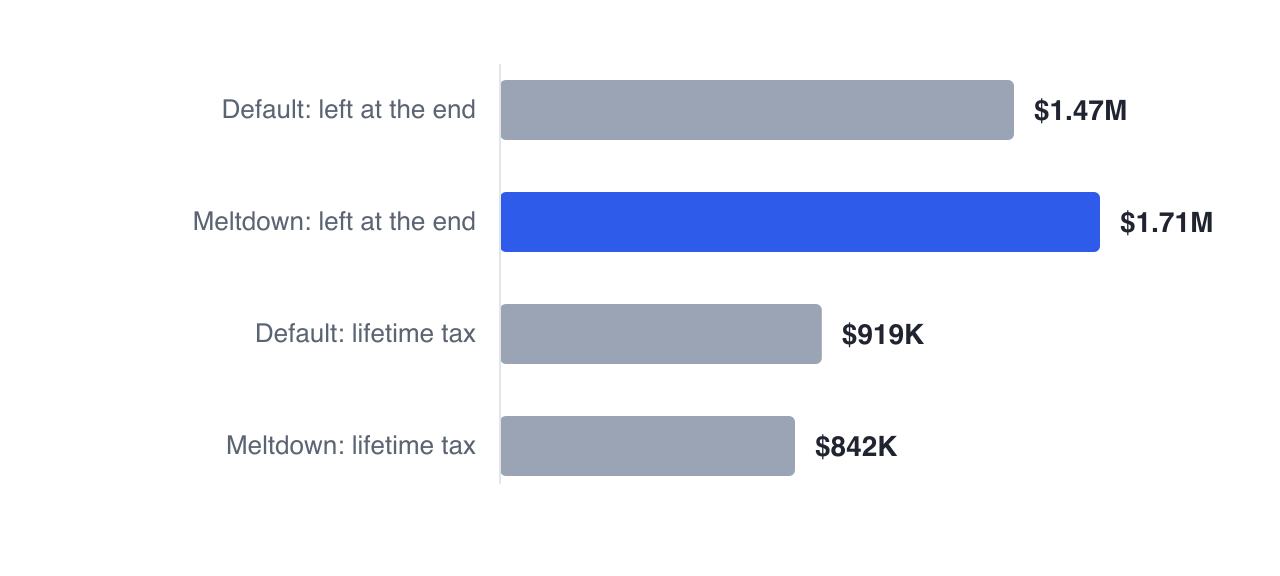
Both numbers moved in the household’s favour here, which is the case for the strategy at its clearest — this household’s income stays clear of the OAS recovery threshold under either order. That is not guaranteed elsewhere: pushing more income out earlier can cross the clawback line for a household closer to it. Check before committing to a rate.
Who it does not suit
- Anyone whose retirement income already fills the low brackets — a large pension leaves no cheap space to fill.
- Anyone heading toward GIS, where the effective rate on an extra withdrawal is the highest in the country.
- Anyone with a modest registered balance, where mandatory withdrawals were never going to be large enough to cause a problem.
For everyone else the strategy is worth testing rather than adopting on principle — which is exactly what the next episode is about, since *how* the meltdown is sized turns out to matter as much as whether to do one.
There is also an estate dimension. Whatever remains in a registered account at the end is taxable in a single terminal return, typically at the top of the schedule, and a beneficiary who is not a spouse receives what is left after that. Moving money to a tax-free account during your lifetime changes what actually reaches them, not just what the balance says.
Turn meltdown on in the assumptions and the projection applies the extra withdrawals, reporting the effect on lifetime tax, the mandatory minimums later, and what is left at the end.
Next: how to size a meltdown — level depletion, and the heuristic we removed.
GlidePathEngine is an educational planning tool — not financial, investment, tax, or legal advice.