The RRSP vs TFSA decision rule
"RRSP when you’re older, TFSA when you’re younger" is the advice most Canadians have heard, and it is a rough proxy for something much more precise. The actual rule fits in one line, and it uses two numbers neither of which is your age.
The rule
That is not a simplification of a more complicated rule. It falls directly out of the arithmetic. Both accounts grow without annual tax, so the growth cancels out of the comparison entirely. What is left is one rate on the way in and one rate on the way out.
The reason "it depends on your age" persists is that age correlates with the rate gap. Early in a career, income is usually low and rising — deducting at a low rate now to be taxed at a higher one later is a bad trade. Later, income peaks and retirement income is lower. The proxy works often enough to be repeated, and fails for anyone whose income does not follow that shape.
Getting the first rate right
Your marginal rate today is the easier of the two, and it is still routinely misread. It is not the tax you pay divided by what you earn — that is your average rate, and it is always lower. Your marginal rate is the combined federal and provincial rate that applies to your next dollar, and it is the only one relevant to a deduction.
It is also not just the bracket. Income-tested credits and benefits that phase out as income rises add to the effective rate. For someone receiving the Canada Child Benefit, for instance, the true rate on an extra dollar can be well above the bracket rate — which makes the deduction correspondingly more valuable.
Getting the second rate right (the hard one)
Your rate at withdrawal cannot be looked up. It depends on how large the RRSP grows, when mandatory withdrawals begin, when you start CPP and OAS, whether you have a pension, whether you can split income with a spouse, and which clawbacks you land in. Estimating it is genuinely the job of a projection, which is the honest reason a single rule of thumb has never settled this argument.
Two effects push that later rate up, and both are easy to underestimate:
- Mandatory RRIF minimums from 72 force income out whether or not it is needed, and the required percentage rises every year.
- Clawbacks stack on top of the bracket. The OAS recovery tax adds 15 points to the effective rate in its range; GIS reduction can add far more at modest incomes.
Priya’s gap is 17 points
Priya — 54, Ontario, single. $118,000 salary, $410,000 in her RRSP and $88,000 in her TFSA, planning to retire at 63.
Priya earns $118,000 in Ontario, which puts her marginal rate at 37.2%. Running her plan forward to 70 — retired at 63, drawing on her accounts alongside CPP and OAS — her marginal rate lands at 19.1%.
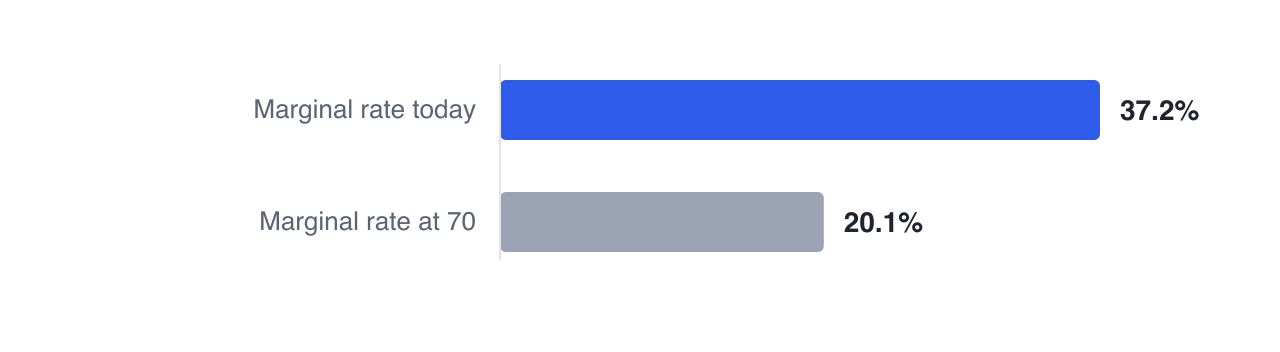
A gap of about 18.1 points is substantial, and it points clearly at the RRSP for her $11,800 a year. Worth noticing: the gap is a *consequence* of her plan, not an input to it. Change her retirement age, her spending, or when she starts CPP, and the second bar moves.
That is the part a rule of thumb cannot capture. The right answer for Priya at 54 is not necessarily the right answer for Priya at 61, and neither is settled by her age.
When the rates are close
Inside a few points, the tax arithmetic is close to a wash and the tiebreakers from episode 3 take over: TFSA withdrawals are invisible to clawbacks, and TFSA room comes back. There is also a diversification argument — holding both means you have a lever to pull in a year when income needs managing, which is worth something on its own.
The projection reports your marginal rate for every year, working and retired, so you can read your own gap instead of estimating it — and the advice panel scores the contribution priority against your objective.
Next: building a plan worth reading these rates off — in about ten minutes.
GlidePathEngine is an educational planning tool — not financial, investment, tax, or legal advice.