Salary versus dividends for an owner-manager
Integration means the total tax on a dollar is roughly the same whether it reaches you as salary or as a dividend. Which sounds like the decision does not matter — until you notice everything else that hangs off the choice.
What salary does
A salary is deductible to the corporation, so it reduces corporate income, and it is ordinary income to you. It also triggers payroll obligations — the corporation and you both pay into CPP.
That first item compounds for decades. An owner-manager paid entirely in dividends accumulates no RRSP room at all, which forecloses one of the two main tax-sheltered accounts for their entire career.
What dividends do
A dividend is not deductible to the corporation — it is paid from after-tax profits — and is taxed to you under the gross-up-and-credit system from episode 36. There are no payroll deductions, no remittances, and no CPP contributions.
Skipping the CPP contribution is often presented as a saving. It is also a forgone benefit: no contribution means no entitlement, and CPP is indexed, guaranteed and lifelong. Whether the trade is good depends on how you would otherwise invest the money, and on how much you value a benefit that cannot be outlived.
One further consequence: the grossed-up dividend, not the cash, is what income-tested benefits are measured against — which matters for anyone approaching the OAS recovery range later in life.
Same pay, two ways
Sam — 41, British Columbia, self-employed through a corporation. No employer pension, no home yet, and a company that pays them both salary and dividends.
Running Sam’s plan with $105,000 of total compensation paid entirely as salary against mostly as dividends, lifetime personal tax is $593,019 against $817,877, and the plan ends at $3,323,059 against $2,590,169.
The mechanism shows up in the RRSP: $550,907 at 60 under all-salary against $441,446 under mostly-dividends. Same total pay, and one version built a materially larger sheltered account.
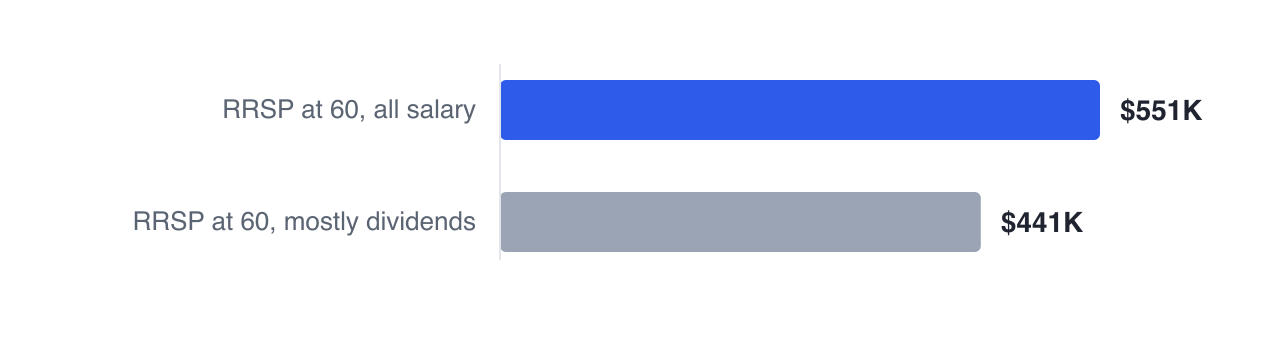
Sam’s case leans toward salary, and it is his particular case rather than a rule. A business with income above the small business limit, an owner who does not want the RRSP room, or a year with unusual cash needs can all reverse it — which is why this is a calculation rather than a policy.
The mix, not the binary
In practice most owner-managers pay a blend — enough salary to generate full RRSP room and CPP entitlement, with dividends beyond that for flexibility. Salary must be reasonable for work actually performed; dividends can be declared as needed and adjust year to year with the business.
The mix also interacts with what the corporation holds. Leaving money inside to invest runs into the passive income rules — which is the next episode.
The corporate section takes an annual salary and dividend, so you can hold total compensation constant and move the split — and see what it does to RRSP room, lifetime tax and the plan.
Next: the passive income grind — how investing inside the corporation raises the tax on the business.
GlidePathEngine is an educational planning tool — not financial, investment, tax, or legal advice.