Selling your corporation and the LCGE
For many business owners the single largest financial event of their life is selling the company. There is an exemption that can shelter over a million dollars of that gain, and it has conditions that cannot be satisfied at the last minute.
What the exemption is
Per person matters: a spouse who genuinely owns shares has their own exemption, which can double the sheltered amount. Genuinely is the operative word — the ownership has to be real, and the arrangements that make it real take years to establish.
The tests
- Shares, not assets. The exemption applies to selling shares. A buyer often prefers to buy assets instead — cleaner liability, a step-up in cost base — so the structure of the deal is itself a negotiation about who gets the tax benefit.
- A holding period. The shares must have been owned by you or a related person throughout the preceding twenty-four months. Transferring shares to a spouse the month before a sale does not create a second exemption.
- An asset test at the moment of sale. Substantially all of the company’s assets must be used in an active business in Canada.
- A second asset test over the holding period. A majority of assets must have been used in an active business throughout the twenty-four months. This is the one that catches companies with large investment portfolios.
The fourth test is where the corporate deferral strategy collides with the exit strategy. A corporation that has accumulated a substantial investment portfolio may fail the asset test precisely because the deferral worked — and fixing it means moving assets out of the company well before a sale, in a process usually called purification.
What the exemption is worth to Sam
Sam — 41, British Columbia, self-employed through a corporation. No employer pension, no home yet, and a company that pays them both salary and dividends.
Selling at 60 for $2,548,679 against a nominal share cost base, Sam’s taxable capital gain is $648,840 with the exemption applied and $1,273,840 without it.
In tax terms the sale year costs $294,906 with the exemption against $629,281 without — $334,375 of tax that turns entirely on whether the tests were satisfied.
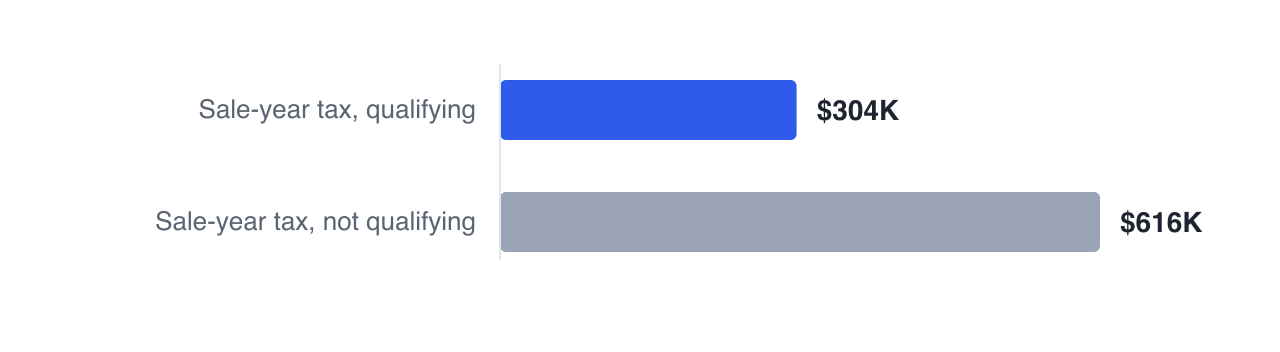
Worth noting what this figure is: the tax in the year of sale. It is not an estate delta, because a one-off tax bill in a projection that funds spending on a gross basis does not change the terminal balance. Quoting an estate figure here would report a zero and mislead — the sale-year tax is the honest number.
The other mechanics of an exit
A sale can be structured with an earnout or vendor financing, spreading proceeds and therefore the gain across years — which can matter for clawbacks even when the exemption covers most of the tax. A capital gains reserve allows some deferral where proceeds arrive over time. And a sale of shares held by a holding company rather than personally changes the analysis entirely, since the exemption is personal.
None of that is arithmetic a projection settles on its own. What a projection can show is what the after-tax proceeds do to the rest of the plan — which is the question the sale was in service of.
The corporate section takes a sale year, the share cost base and whether the shares qualify — so the sheltered gain, the tax and the net proceeds landing in your accounts are all projected.
Next: what happens to a corporation you never sold, on the day you die.
GlidePathEngine is an educational planning tool — not financial, investment, tax, or legal advice.