Sensitivity testing in thirty seconds
A plan has a dozen inputs and they are not equally important. Finding out which ones your answer is genuinely sensitive to takes about half a minute, and it usually reorders what you assumed was worth worrying about.
The method
Move one input by a plausible amount, note how far the outcome moves, put it back. Repeat. Rank the inputs by the size of the move. That ranking is your plan’s sensitivity profile, and it is specific to you — a lever that dominates one household barely registers in another.
What usually dominates
For most households the ranking comes out in a similar order, and it is not the order people expect:
- Retirement age, because it moves contributions and withdrawals at the same time — the double effect from episode 69.
- Spending, which scales almost everything downstream of it.
- Fees, which compound against you every year with certainty.
- Drawdown order, which is free to change and often worth more than the return assumption.
- Expected return, which matters enormously over long horizons and less than people think across the range of assumptions that are actually defensible.
- Benefit timing, which is usually worth real money and rarely decisive.
The interesting part of that list is what sits low on it. Return assumptions and CPP timing attract most of the discussion; retirement age and fees do more of the work.
Priya’s ranking
Priya — 54, Ontario, single. $118,000 salary, $410,000 in her RRSP and $88,000 in her TFSA, planning to retire at 63.
Against a baseline of $399,597: retiring three years early gives $37,505, a two percent fee gives $1,183, changing the drawdown order gives $547,069, and deferring benefits to 70 gives $418,262.
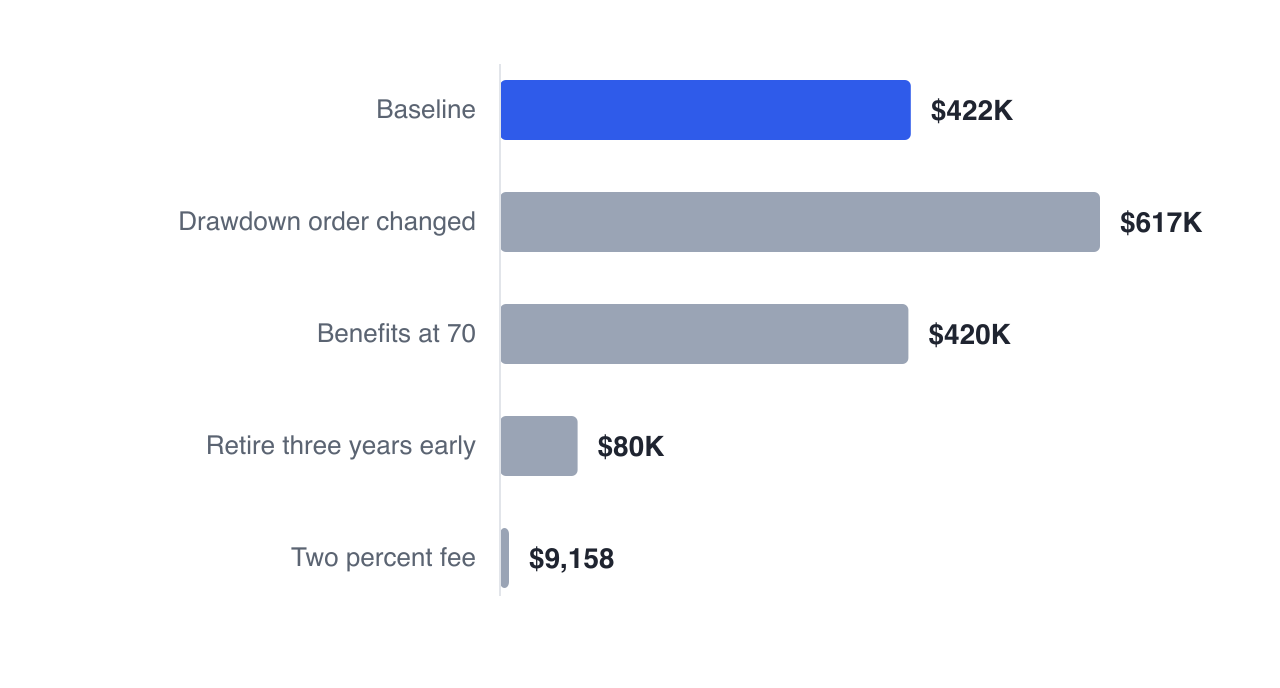
Two things stand out. The fee — the smallest-looking number of the four inputs — does the most damage. And benefit timing, which generates the most debate anywhere retirement is discussed, barely moves her outcome at all. For Priya specifically, that debate is not where the money is.
What to do with the ranking
Spend your attention at the top and stop worrying about the bottom. If benefit timing moves your answer by a rounding error, choose on non-financial grounds — when you want the income, how you feel about the risk — and move on. That is not laziness; it is allocating a limited amount of decision-making to where it changes something.
It also tells you which assumptions deserve scrutiny. An input the plan is highly sensitive to is one worth getting right; an input it barely notices can be left at a reasonable default without guilt.
The tweak tray moves each major input with a slider and the projection re-runs live, so the whole ranking exercise takes about as long as reading this episode did.
Next: where you retire changes the math — thirteen provinces, thirteen answers.
GlidePathEngine is an educational planning tool — not financial, investment, tax, or legal advice.