Separation and the retirement plan
Dividing the assets is the part everyone focuses on and the part the lawyers handle. The financial shock that follows is different: two households now cost more than one did, and every tax efficiency that depended on being a couple has gone.
The mechanics of dividing registered money
Registered accounts can be divided between separating spouses on a tax-free rollover basis, provided there is a written agreement or court order and the prescribed form is used. Done correctly, no tax is triggered by the transfer itself.
Done incorrectly — one spouse simply withdrawing money to pay the other — the withdrawal is fully taxable to the person who made it, and the room is gone permanently. That is an entirely avoidable and often very large error.
A TFSA is not divided by rollover. Transferring value between separating partners uses a specific mechanism and the room follows particular rules — worth confirming rather than assuming, because a mishandled TFSA transfer can create an over-contribution penalty.
The efficiencies that disappear
- Pension income splitting ends, so income that was spread across two returns is taxed on one — the same effect as the survivor transition in episode 41.
- Spousal credits end, along with any transfer of unused credits.
- One household of fixed costs becomes two. Housing, utilities and property costs do not halve.
- Any spousal RRSP strategy that was building balance in the lower earner’s name stops being relevant, and the accumulated imbalance is now a fact of the settlement rather than a plan.
The pension-splitting loss deserves emphasis because it is the least visible. It does not appear in any settlement calculation and it recurs every year for the rest of both lives.
What their imbalance means in a division
Dan & Marie — 58 and 56, Alberta. Dan retires at 62 with a defined-benefit pension; Marie retires at 60. Their RRSPs are very different sizes, which matters later.
Dan holds $540,000 of registered savings against Marie’s $165,000, plus a defined benefit pension. Equalising the household means valuing the pension — a specialised calculation — and rolling registered money across to balance it.
Their combined plan ends at $1,747,650, and it loses $37,372 of splitting benefit the moment they separate. Each of them will also lose one OAS from the household when the other dies — but separately now, with no survivor rollover between them.
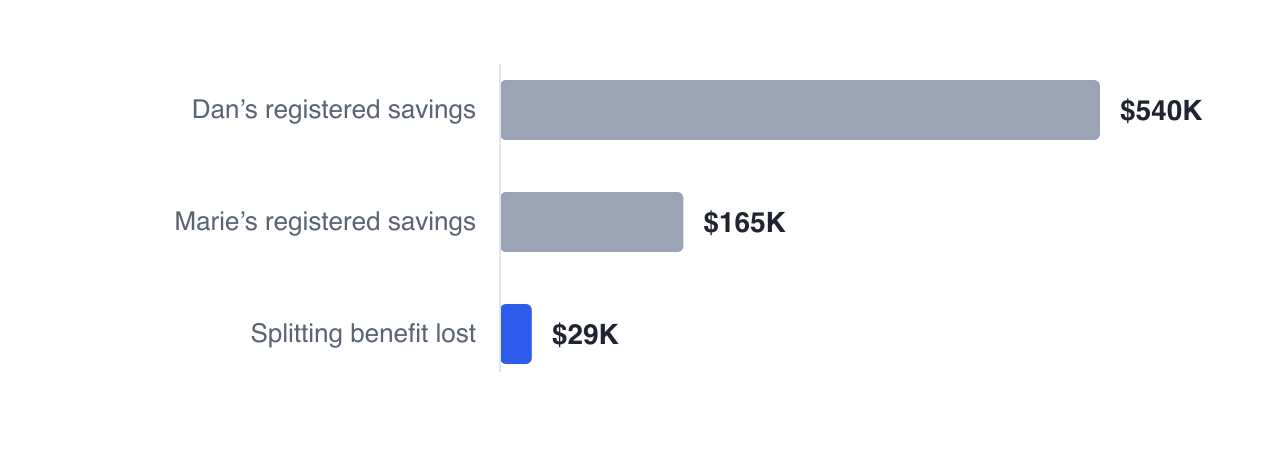
The third bar is the one that never appears in a settlement negotiation, and the $8,999 of OAS each of them keeps individually is unchanged. What changed is that neither of their plans can lean on the other any more.
Rebuilding, practically
The useful exercise is to build two plans, each as a single-person household with its own assets, income, spending and horizon. Not one plan halved — the fixed costs, the single-filer tax treatment and the absence of a survivor rollover all change the answer.
Doing that before a settlement is final is also the only way to see whether a proposed division produces comparable retirements. Two plans is a five-minute exercise and it answers a question that face-value arithmetic cannot.
Create a separate plan for each household with its own assets and income, and compare the readiness and the income they each produce — which is what an equal division was trying to achieve.
Next: retiring earlier than you planned to, modelled honestly.
GlidePathEngine is an educational planning tool — not financial, investment, tax, or legal advice.