Sequence-of-returns risk
While you are saving, the order of your returns barely matters — only the compound average does. The day you start withdrawing, order becomes one of the largest risks in the plan, and it is concentrated in a window of about five years.
Why order matters only when you withdraw
If you never take money out, a bad year followed by a good year and a good year followed by a bad year produce exactly the same balance. Multiplication is commutative; the sequence cancels out.
Withdrawals break that symmetry. A withdrawal taken during a downturn sells units at a depressed price, and those units are not there to participate in the recovery. The same withdrawal taken after a recovery sells fewer units for the same money. The average return over the period can be identical and the balances at the end will not be.
What this does and does not justify
The risk is real, and it is often used to justify things it does not support. It is not an argument for market timing, and it is not an argument for abandoning growth assets across a thirty-year retirement — inflation over that horizon is its own serious risk.
What it does support is having some flexibility in the first few years: a cash or short-bond buffer that can fund spending without selling into a decline, spending that can flex downward temporarily, or a retirement date with some give in it. Each of those reduces the number of units you are forced to sell at the wrong price.
The spread hiding behind one line
Priya — 54, Ontario, single. $118,000 salary, $410,000 in her RRSP and $88,000 in her TFSA, planning to retire at 63.
Priya’s single projection ends at $399,597 — a clean line drawn through the middle of a much messier reality. Running the same plan a thousand times with different return sequences around the same expected return, the plan funds her spending in 75.7% of them.
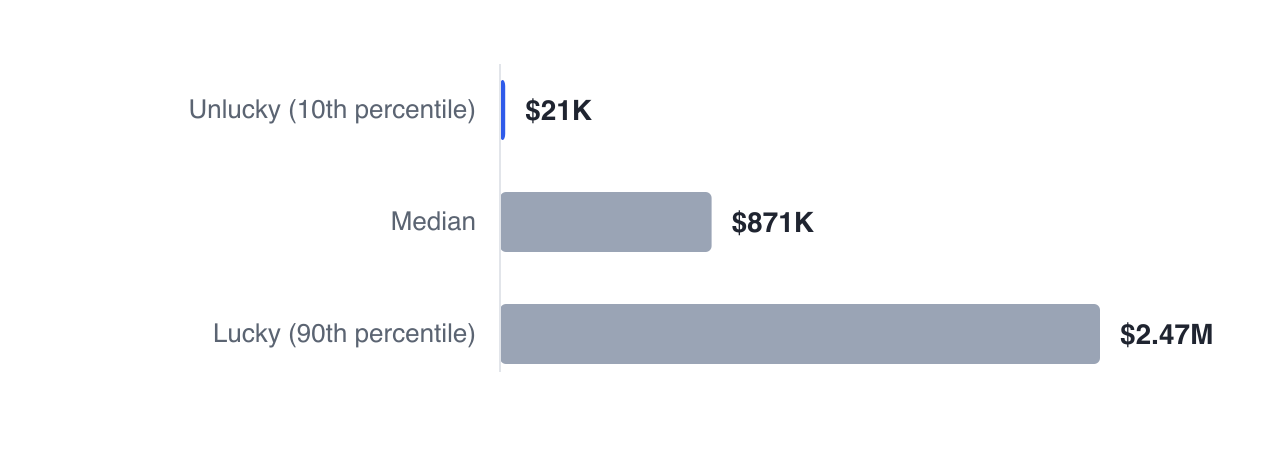
The left-hand bar is the one worth sitting with. Nothing about Priya’s behaviour differs between those three outcomes — same savings, same spending, same retirement at 63. The difference is which years the poor returns landed in.
The flexible year
One thing worth knowing about your own plan: how much of your first-few-years spending is genuinely fixed and how much could pause in a bad year. A plan where a fifth of spending is discretionary has a lever that a plan of pure fixed costs does not — and the lever is most valuable in exactly the window where sequence risk bites.
A related asymmetry is worth noting. Mandatory withdrawals from a registered account are calculated as a percentage of the opening balance, so a market drop reduces the required dollars the following year. That softens the forced-selling problem slightly. Fixed spending does the opposite: the same dollar need against a smaller portfolio is a larger percentage withdrawal, exactly when it hurts most.
The Monte Carlo simulation re-runs your whole plan across a thousand return sequences and plots the confidence bands, so you can see the spread your single line is drawn through.
Next: how to read the number that simulation gives you, without over- or under-reacting.
GlidePathEngine is an educational planning tool — not financial, investment, tax, or legal advice.