Surplus income: when forced income exceeds need
A retirement plan usually worries about not having enough. There is an opposite problem that is almost as common and far less discussed: being forced to take out more than you want to spend, year after year, with no say in the matter.
How a surplus happens
Several income sources in retirement are not optional. CPP and OAS arrive once started. A pension pays what it pays. Mandatory registered withdrawals are set by a table and a balance. None of them consult your spending plan.
Add them up and a household can easily find that forced income exceeds what they actually spend — particularly in the years after mandatory withdrawals begin, and particularly for households whose spending naturally declined as they aged.
Why reinvestment is the honest default
Real households do not incinerate surplus income. It accumulates in a savings account, goes into a TFSA if there is room, or is invested. Modelling it as disappearing would be modelling a behaviour nobody has.
One detail matters for correctness: the reinvested amount is already-taxed money, so its cost base is set to the full deposit. Getting that wrong would tax the same dollars a second time as capital gains later — a small modelling decision with a compounding consequence.
A still-working spouse’s salary is excluded from this, incidentally. Salary is consumed and contributed in the ordinary way; it is not surplus retirement income, and treating it as such would double-count.
What the surplus is worth
Dan & Marie — 58 and 56, Alberta. Dan retires at 62 with a defined-benefit pension; Marie retires at 60. Their RRSPs are very different sizes, which matters later.
Dan and Marie spend $96,000 a year. Dan’s mandatory withdrawal alone is $46,856 at 72, on top of two CPPs, two OAS payments and a pension. Their forced income runs well ahead of their spending for most of their retirement.
With that surplus reinvested, their plan ends at $1,747,650. With it discarded, it ends at $654,690 — a difference of $1,092,961, which is not a strategy at all. It is simply what happens to money that was taken out and not spent.
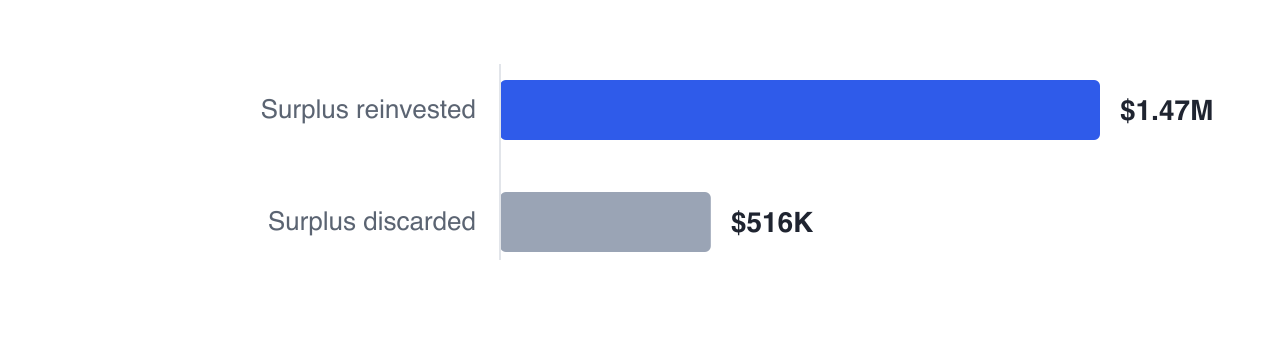
The size of that gap is the reason this episode exists. It is not advice — it is a warning about how much a projection’s outcome can depend on an assumption its user never saw. Any tool that shows you a terminal number is making some assumption here.
What to do with it
TFSA room first, where it exists — the surplus then grows and eventually passes without tax. Beyond that, a taxable account, where at least only the growth is taxed and only at the capital gains inclusion rate. Or spend it: a persistent surplus is also evidence that the plan can support more than it is being asked to.
The cash flow view shows income against the retirement income target for every year, so a persistent gap between them is visible — along with what the projection is assuming happens to it.
Next: the bridge — spending an RRSP deliberately in order to delay CPP.
GlidePathEngine is an educational planning tool — not financial, investment, tax, or legal advice.