Tax instalments in retirement
Somewhere in the first couple of years of retirement a letter arrives from the CRA asking for tax in quarterly instalments. It is not an audit and not a penalty — it is the consequence of no longer having an employer doing the withholding.
Why it happens
An employee’s tax is remitted continuously through payroll. A retiree’s income arrives from several sources with inconsistent withholding — some with none at all, as the previous episode described — so the tax accumulates and is settled at filing.
It is backward-looking, which is what makes it feel arbitrary. The instalment request arrives because of a year that has already been filed, so by the time you see it the behaviour that caused it is a year or more in the past.
Three ways to satisfy it
- Pay the amounts the CRA proposes. Doing this exactly protects you from interest even if the amounts turn out to be too low — the safest option and often not the cheapest.
- Pay based on last year’s actual tax, divided into four.
- Pay based on your estimate of this year’s tax. Best when income is falling, and it carries the risk: if the estimate is short, interest is charged on the shortfall.
The third option is the one that matters in retirement, because retirement income often moves year to year. A retiree whose income fell after a one-off event — a property sale, a large withdrawal — is being asked for instalments sized by a year that will not repeat.
The alternative: withhold more instead
Instalments are not the only route. You can request additional tax be withheld at source from CPP, OAS or a pension, or ask for a higher rate on discretionary registered withdrawals. Enough withholding and the instalment requirement never triggers.
For most people this is administratively simpler — one form rather than four payments a year and a calculation each time. It costs the use of the money slightly earlier, and it removes an annual chore and the risk of a missed deadline.
Priya’s exposure
Priya — 54, Ontario, single. $118,000 salary, $410,000 in her RRSP and $88,000 in her TFSA, planning to retire at 63.
In her age-70 year Priya reports $35,267 of taxable income and owes $2,450 — a small enough amount that instalments may not be required at all. Not every retiree meets the threshold.
Two years later her mandatory RRIF withdrawal alone is $43,909, none of it withheld at source. That is the year the balance owing appears, and the instalment request follows the year after.
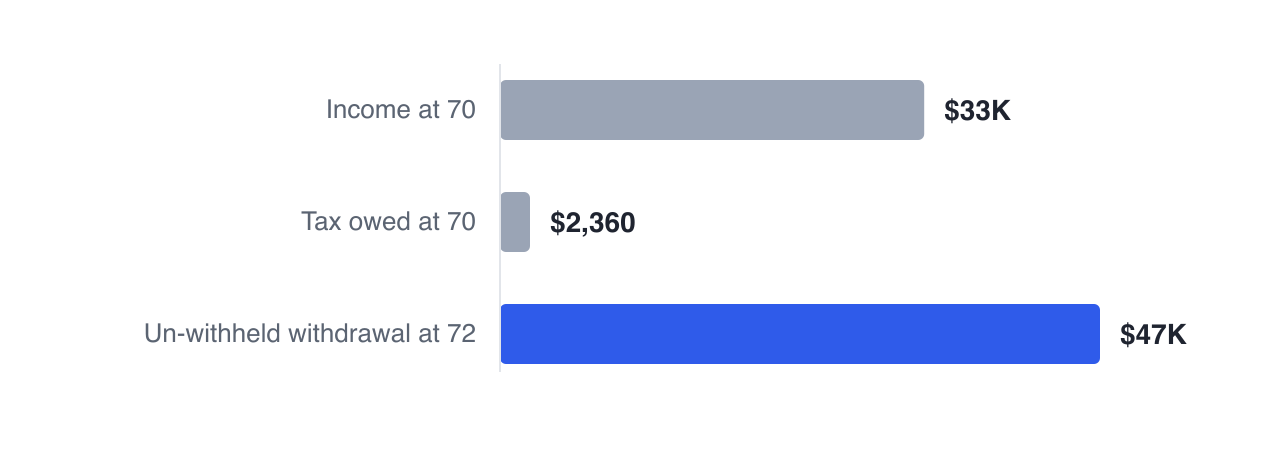
The pattern is worth recognising because it is almost universal: the mandatory withdrawal schedule arriving without withholding is what moves most retirees onto instalments, and it happens at a predictable age.
What a plan can tell you in advance
A projection reports tax for every year, so the years where a substantial balance will be owing are visible long before a letter arrives. That is enough to arrange additional withholding ahead of time, which is the cheapest way to make this whole subject go away.
It is a small piece of administration with an outsized nuisance value, and it is entirely predictable from the plan you already have.
The ledger shows income tax by year across the whole projection, so the years likely to trigger an instalment requirement are identifiable before they happen.
Next: what your plan would have done starting in 1972.
GlidePathEngine is an educational planning tool — not financial, investment, tax, or legal advice.