Tax-loss and tax-gain harvesting
Realising a loss to reduce tax is well known. Realising a gain to reduce tax sounds like nonsense until you notice that a retiree in a low-income year can often do it for almost nothing — and reset their cost base permanently.
Loss harvesting
Selling a holding that has fallen realises a capital loss. That loss offsets capital gains realised in the same year; anything unused can be carried back against gains in the three previous years, or carried forward indefinitely. The proceeds are then reinvested, and the portfolio’s exposure is broadly restored.
What harvesting a loss actually buys is deferral, not elimination. The reinvested position has a lower cost base, so a larger gain waits in the future. That is still worth doing if the tax saved today is at a higher rate than the tax paid later, and it is worth much less if the rates are the same.
Gain harvesting
The opposite move: deliberately selling an appreciated holding in a low-income year and immediately buying it back. The gain is realised at a low rate, the cost base steps up permanently, and future gains from that point are smaller.
The thirty-day rule does not apply, because it only denies losses. Repurchasing immediately after realising a gain is entirely permitted, which makes this the cleaner of the two operations mechanically.
The window is the same one the meltdown episode identified: the years between the last paycheque and the first mandatory withdrawal, when taxable income is unusually low and bracket space is going unused.
The rate gap makes the case
Priya — 54, Ontario, single. $118,000 salary, $410,000 in her RRSP and $88,000 in her TFSA, planning to retire at 63.
Priya holds $79,394 in a taxable account at retirement — the only account where any of this applies. Her marginal rate while working is 37.2% and at 70 it is 19.1%.
Since only 50% of a gain is included in income, the effective rate on a realised gain is roughly half the marginal rate — so realising a gain in a retirement year costs a fraction of what the same realisation costs during her working life.
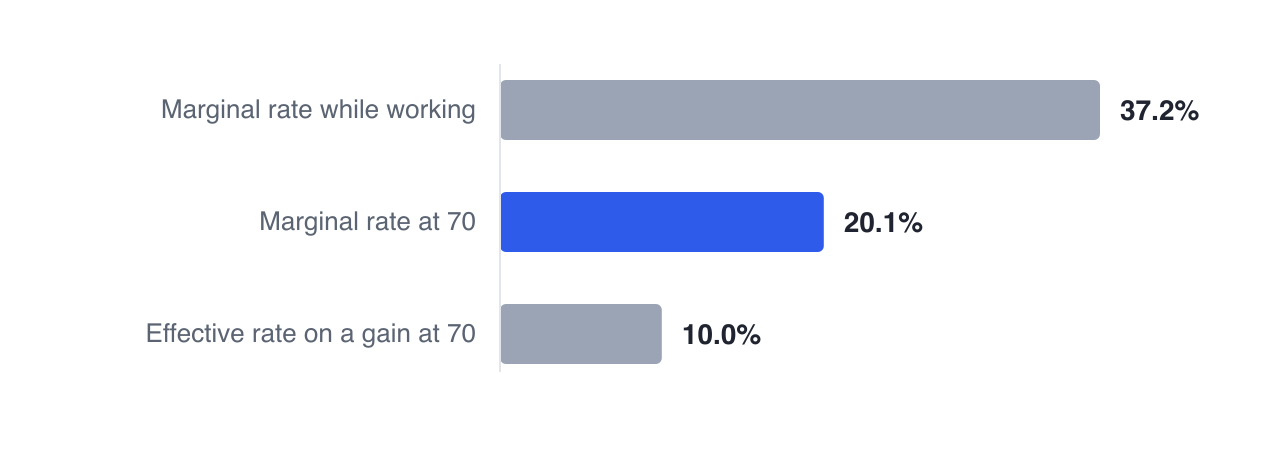
The third bar is what a deliberate realisation actually costs her. Against a terminal return where the whole accumulated gain is realised at once, that is a meaningful difference on the same dollars.
Why this is advisory rather than measured
A projection models a return per account, not the individual holdings inside it, so it cannot know which positions carry gains or losses in any given year. It can identify the low-income window where gain harvesting is cheapest — which is the useful part — but it will not report a dollar figure for a technique it cannot actually simulate.
That is a deliberate limit. A number produced by a model that does not track the underlying mechanism would be more convincing than it deserves to be.
The ledger shows taxable income for every year of the plan, which is where the harvesting window is — the years between the last salary and the first mandatory withdrawal, sitting in plain sight.
Next: what happens when forced income exceeds what you actually need.
GlidePathEngine is an educational planning tool — not financial, investment, tax, or legal advice.