TFSA: "tax-free" is the least interesting thing about it
Everyone can tell you a TFSA is tax-free. Far fewer can tell you the two properties that actually make it the most flexible account in the Canadian system — and both of them matter most at the exact moment you are trying to live off your savings.
Property one: withdrawals are invisible
A TFSA withdrawal is not income. Not "income taxed at 0%" — not income at all. It does not appear on your tax return, and it does not appear in the calculation of anything that is tested against your income.
That second half is the part people miss. The Canadian retirement system is full of income-tested thresholds: the OAS recovery tax (which claws back Old Age Security above an income threshold), the Guaranteed Income Supplement (reduced as other income rises), the age amount, and various provincial benefits and drug plans. Each one looks at a version of your net income. A TFSA withdrawal is absent from all of them.
An RRSP withdrawal is present in all of them, at full value. That distinction can be worth more than the tax saving itself, and it is the reason a TFSA is so useful for managing a single expensive year — a new roof, a car, a medical cost — without disturbing benefits that are calculated on your income.
$20,000 out of three accounts
Priya — 54, Ontario, single. $118,000 salary, $410,000 in her RRSP and $88,000 in her TFSA, planning to retire at 63.
Suppose Priya needs $20,000 for a one-off expense in retirement. The money is available in all three of her accounts. What changes is what the withdrawal adds to her taxable income — which in turn decides her tax bill and her exposure to every income-tested threshold above.
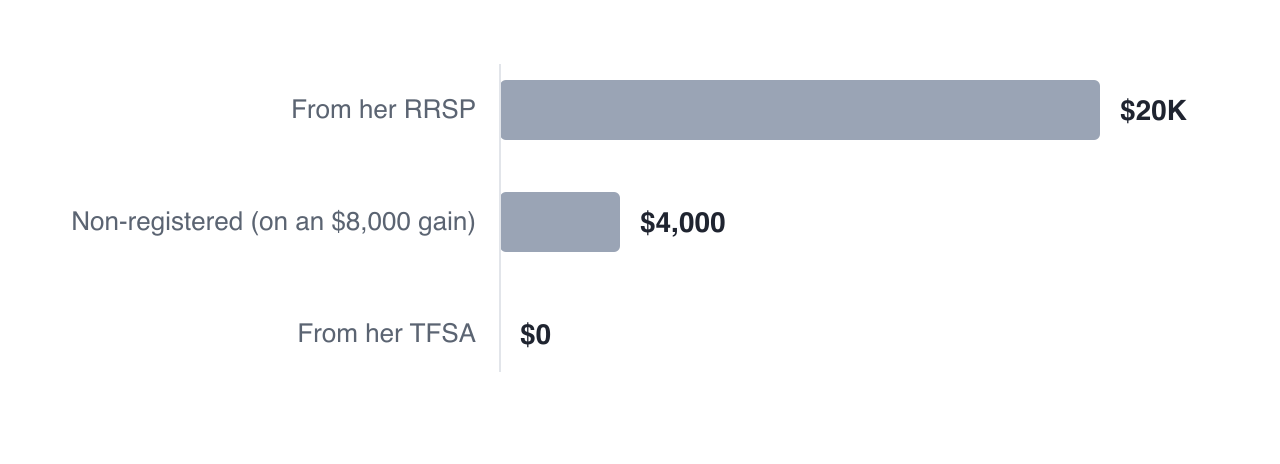
The non-registered case is worth a note: only the gain is taxable, and only 50% of it. Returning your own capital is not income. That is why the middle bar is small rather than zero — and why it depends entirely on what you paid for the investment, not on what you withdrew.
Priya's TFSA is $88,000 today and is projected to reach about $132,279 by the time she stops working at 63. That is not a large slice of her total savings. It is, however, the slice she can draw on in any amount, in any year, without moving a single number on her tax return.
Property two: the room comes back
Withdraw from an RRSP and that contribution room is gone permanently. You cannot put it back. Withdraw from a TFSA and the full amount you took out is added back to your contribution room — on January 1 of the following year.
That makes the TFSA the only registered account that can be used and refilled. It is a genuine emergency fund that also happens to be a long-term investment account, which is an unusual combination and the reason so much planning advice ends up pointing at it.
What the TFSA is not
It is not a savings account, despite the name. The "TFSA" is a tax wrapper — what goes inside it is up to you, and holding cash in one is a choice, not a requirement. It is also not a competitor to the RRSP in the way the framing usually implies; for most people the two answer different questions, which is where this series goes next.
Put a one-off expense into your plan and watch which account funds it, what it does to that year’s taxable income, and whether it moves your OAS.
Next: the actual decision rule for RRSP versus TFSA — and why "it depends on your age" is the wrong version of it.
GlidePathEngine is an educational planning tool — not financial, investment, tax, or legal advice.