The bridge: spending the RRSP to delay CPP
Two strategies from earlier in this series turn out to be the same strategy. Deferring CPP needs the gap years funded from somewhere; melting down an RRSP needs a reason to withdraw in exactly those years. Each solves the other’s problem.
What the bridge is
Framed that way it is an annuity purchase, and a very cheap one: no commission, no insurer credit risk, full inflation indexing, and pricing set by legislation rather than by a market. Nothing available commercially matches those terms.
The second benefit, which is easy to miss
The withdrawals that fund the bridge are drawn from the registered balance in the household’s lowest-income years — precisely the meltdown window from episode 52. So the strategy simultaneously reduces the balance that mandatory withdrawals will later apply a percentage to.
That is a genuine double effect: a larger guaranteed income later, and a smaller forced income later. A household doing the bridge for the first reason gets the second for free.
What it costs
- A visibly smaller portfolio in your late sixties. This is psychologically harder than it looks on a spreadsheet — the balance falls fast, and the compensating benefit has not started yet.
- Sequence risk concentrated in the bridge years, because withdrawals are large and the portfolio is being drawn hard exactly when a downturn would hurt most.
- A larger taxable pension for life, which for some households means more clawback, not less.
- Nothing recovered if you die early. The larger pension is worth more the longer you live, and worth nothing at all to your estate.
The trade, priced
Dan & Marie — 58 and 56, Alberta. Dan retires at 62 with a defined-benefit pension; Marie retires at 60. Their RRSPs are very different sizes, which matters later.
Dan retires at 62. Deferring both spouses’ benefits to 70 rather than 65 raises lifetime CPP from $995,049 to $1,156,066 — roughly $161,017 more guaranteed indexed income across their retirement.
Scored on what is left at the end, the same change moves them from $1,747,650 to $1,713,235 — slightly worse. The extra pension is real, and so is the cost of funding five years of spending from their own accounts to get it.
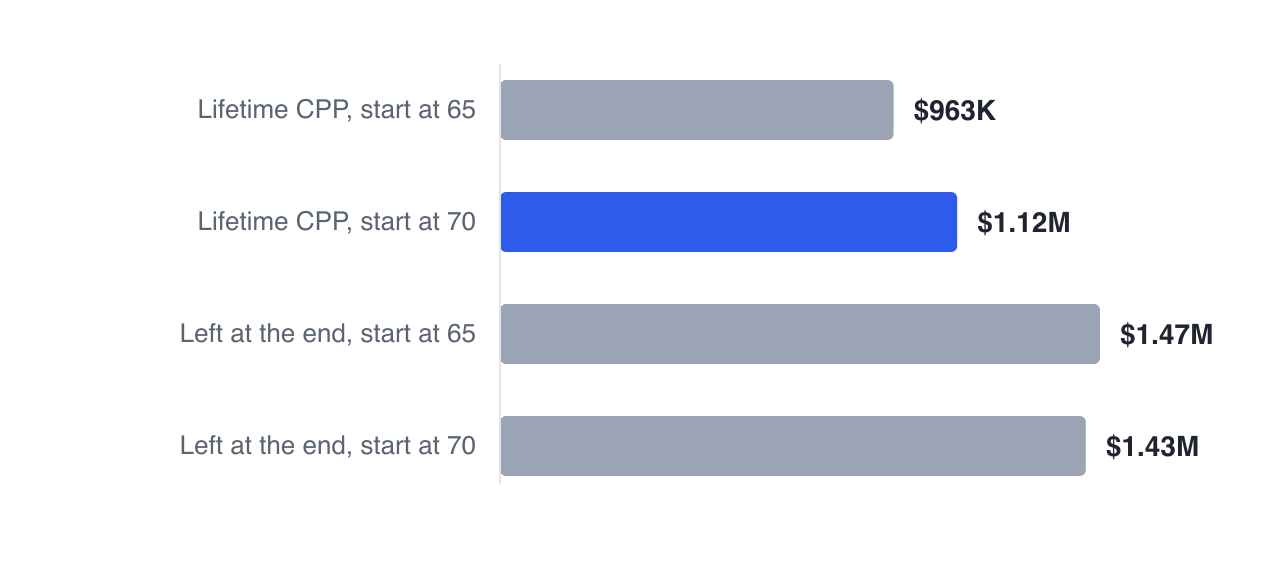
Which of those two you weight more heavily is not an arithmetic question. A household worried about outliving its money values the left pair; a household focused on what it leaves behind values the right pair. The bridge is the same strategy either way — it just scores differently depending on what you are asking of the plan.
Who it suits
Households with substantial registered balances, good health, longevity in the family, and more concern about outliving their money than about their estate. The single clearest case is someone with a large RRSP retiring in their early sixties — the balance needs drawing down anyway, and the deferral pays for it.
The timing optimizer scores CPP and OAS start ages jointly against your plan, and the ledger shows what funding the gap years does to your balances — both halves of the trade, on your numbers.
Next: the FIRE number, computed properly — and what we deliberately do not subtract.
GlidePathEngine is an educational planning tool — not financial, investment, tax, or legal advice.