The FIRE number, computed properly
The financial independence number is simple arithmetic: income divided by a withdrawal rate. The interesting part is a subtraction that looks obviously correct, makes the target meaningfully smaller, and quietly breaks the plan for anyone retiring early.
The calculation
Using income rather than spending is deliberate. Spending is what you happen to do this year; income is the capacity the portfolio has to replace, and it includes the savings you would stop making, the tax you would still owe, and the flexibility to spend differently later.
It is also a per-person number rather than a household one. Two people with different incomes have different targets, and pooling them into one household figure obscures which of the two is closer.
The subtraction we do not make
The tempting adjustment is to subtract future guaranteed income — CPP, OAS, a pension — from the target before dividing. The reasoning is that the portfolio only has to cover the gap. It sounds right, and it fails on timing.
Someone retiring at 50 and starting benefits at 70 has twenty years in which the portfolio covers the entire income and those benefits contribute nothing. Netting them out of the target understates what is needed for exactly the period when the need is greatest — and the error is largest for the people most likely to be running the calculation.
Priya’s number, and the tempting version
Priya — 54, Ontario, single. $118,000 salary, $410,000 in her RRSP and $88,000 in her TFSA, planning to retire at 63.
Priya earns $118,000. At 4%, her FI number is $2,950,000. Her plan peaks at $917,791, so she reaches a substantial fraction of it without ever reaching the whole thing — which is entirely normal and does not mean the plan fails.
Netting out her eventual $18,092 of CPP and $8,999 of OAS would cut the target to $2,272,725 — a far more encouraging figure for benefits that do not start until 65.
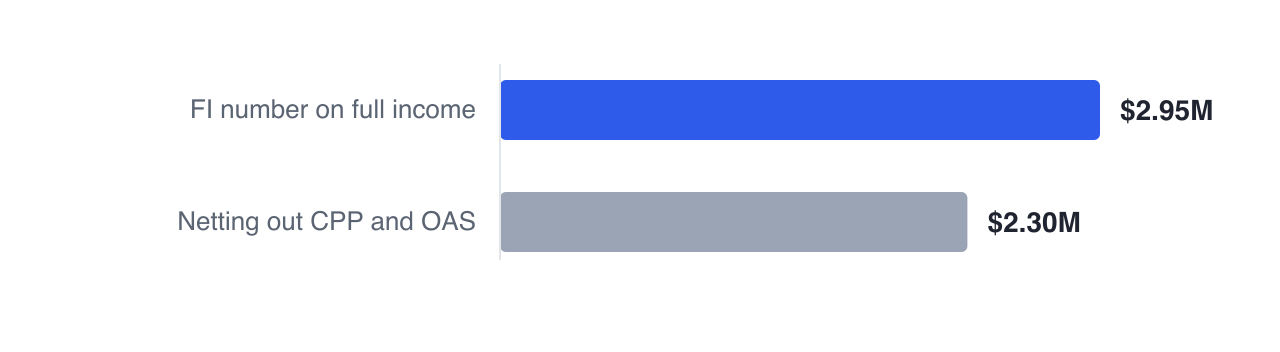
Priya retires at 63 and starts benefits at 65, so the gap is only two years and the error would be modest. For someone retiring at 50 it is twenty years, and the same subtraction would take a plan that works and make it look finished a decade early.
What the number is genuinely good for
It converts an abstract goal into a single trackable figure, and it makes the effect of lowering your income needs vivid: cutting required income by a tenth cuts the target by a tenth — twenty-five times the annual saving. Very few levers in a plan have that multiple attached to them.
It is a milestone, in other words, rather than a plan. Which is also why the withdrawal rate underneath it deserves its own episode later in this series.
The FIRE calculator reports the number per person, the percentage reached, and the age the projection expects to reach it — with the withdrawal rate adjustable so you can see how much of the answer is the convention.
Next: Coast FI — the point where you can stop contributing entirely.
GlidePathEngine is an educational planning tool — not financial, investment, tax, or legal advice.