The 4% rule: where it came from, and its limits
The most quoted number in retirement planning came from a single study of American market history, tested a thirty-year horizon, and assumed a spending pattern almost nobody follows. It is genuinely useful, and it is not a rule.
What the research actually asked
The original work tested a narrow question: for a portfolio of US stocks and bonds, what initial withdrawal rate — increased annually with inflation and never adjusted otherwise — would have survived every historical thirty-year period? The answer was close to four percent.
Every one of those is a modelling choice, and each one matters. It was excellent research answering the question it posed. The rule that escaped into common usage is a much broader claim than the research supported.
Where it stops applying to a Canadian retiree
- Taxes. A four percent withdrawal from a registered account is not four percent of spendable income. The study’s portfolio had no tax treatment at all, and a Canadian retiree’s does.
- Fees. A one-percent fee against a four-percent withdrawal is a quarter of the income. The study assumed none.
- Mandatory withdrawals. The RRIF schedule forces more than four percent out from the first year and rises annually. A Canadian retiree with a large registered balance cannot follow the rule even if they want to.
- Guaranteed income. CPP and OAS mean the portfolio does not have to produce the whole income, which the study’s framing has no way to represent.
- Horizon. Thirty years does not cover someone retiring at 55, and over-covers someone retiring at 70.
The third point is the sharpest. The rule assumes withdrawals are your choice; the RRIF schedule from episode 21 removes that assumption entirely for the largest account most Canadian retirees own.
The rule against Priya’s actual plan
Priya — 54, Ontario, single. $118,000 salary, $410,000 in her RRSP and $88,000 in her TFSA, planning to retire at 63.
At 4%, Priya’s FI number is $2,950,000 — the portfolio the rule says she would need to replace her income. Her actual plan does not work that way at all.
She spends $58,000 a year, receives $18,092 of CPP and $8,999 of OAS from 65, and is forced to withdraw $43,909 at 72 whether she wants it or not. Three of those four numbers have no place in the rule’s framework.
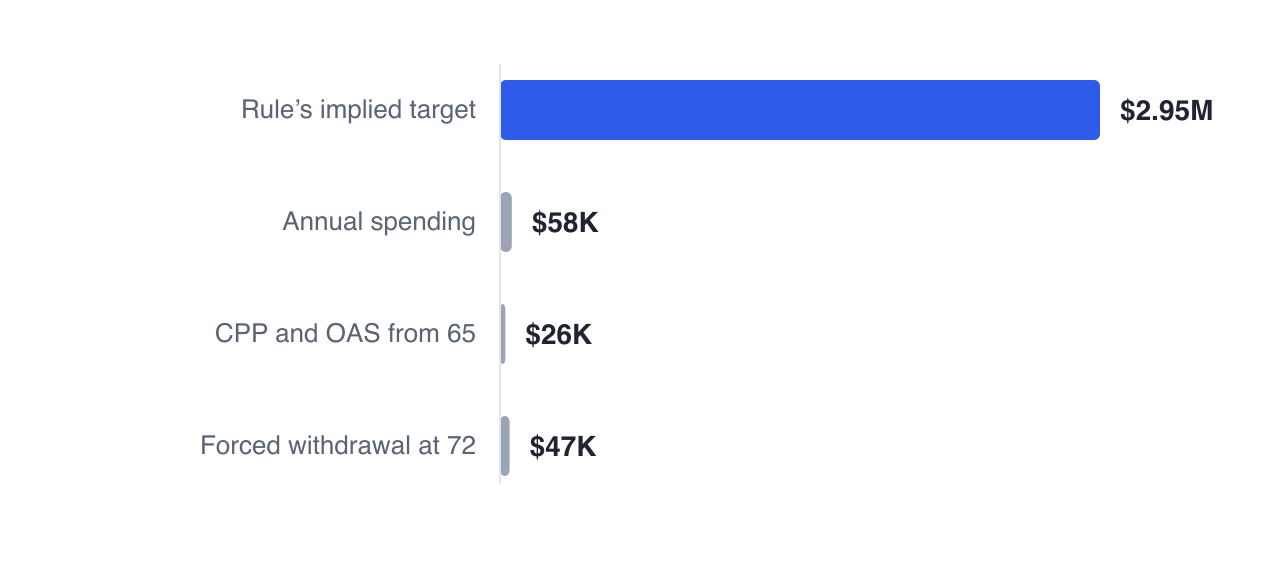
The last two bars are the ones that break the framework. Guaranteed income means the portfolio does not carry the whole load, and a mandatory withdrawal means the withdrawal rate is not hers to set. The rule is answering a question her plan does not pose.
What it is still good for
As a sanity check it is excellent. If your plan implies drawing eight percent of a portfolio for thirty years, something is wrong and the rule tells you instantly. As a sizing shortcut it converts an income need into a rough capital target in one division.
And as a piece of intellectual history it is worth knowing, because the number is quoted constantly by people who have never read what it tested. A projection that models your taxes, your fees, your benefits and your mandatory withdrawals is answering the question the rule was approximating — which is why the two disagree, and why the disagreement is not a problem.
The FIRE calculator applies a withdrawal rate you choose, so you can see the rule’s target alongside what the full projection — with tax, benefits and forced withdrawals — actually says.
Next: reading the cash flow chart — income, tax and spending in one picture.
GlidePathEngine is an educational planning tool — not financial, investment, tax, or legal advice.