Aging parents and the sandwich decade
Your fifties are the decade the previous episodes described as the best for catch-up contributions and the widest tax-rate gap. They are also, increasingly, the decade someone else’s care needs arrive — and the collision is rarely in anyone’s plan.
The three costs
- Direct financial support — topping up a parent’s income, paying for care, covering a gap between what a facility charges and what a pension provides.
- Lost income — reducing hours, declining a promotion, or leaving work entirely to provide care. This is usually the largest of the three and the least visible.
- Lost contributions and compounding — the years of saving that do not happen, in the decade they are worth the most.
It also has a compounding career effect that no projection captures: reduced hours in your fifties can lower the trajectory for the years that follow, not just the years taken off.
What can be established in advance
Whether a parent’s own resources — pension, savings, home equity, provincial subsidy — cover their likely care. Whether powers of attorney exist for property and personal care, because without them a family cannot act on a parent’s behalf at all. And how the responsibility is expected to be shared among siblings.
None of those conversations is comfortable and all of them are cheaper than the alternative, which is discovering the answers during a crisis with no authority to act.
Sizing both risks at once
Priya — 54, Ontario, single. $118,000 salary, $410,000 in her RRSP and $88,000 in her TFSA, planning to retire at 63.
Priya is 54 — squarely in the window. Two scenarios bracket the range. Supporting care at $75,000 a year for three years costs her plan $218,282 against a baseline of $399,597.
Leaving work three years early instead takes the plan to $37,505 and her simulated success rate from 75.7% to 42.8%. The lost career years cost considerably more than writing the cheque would have.
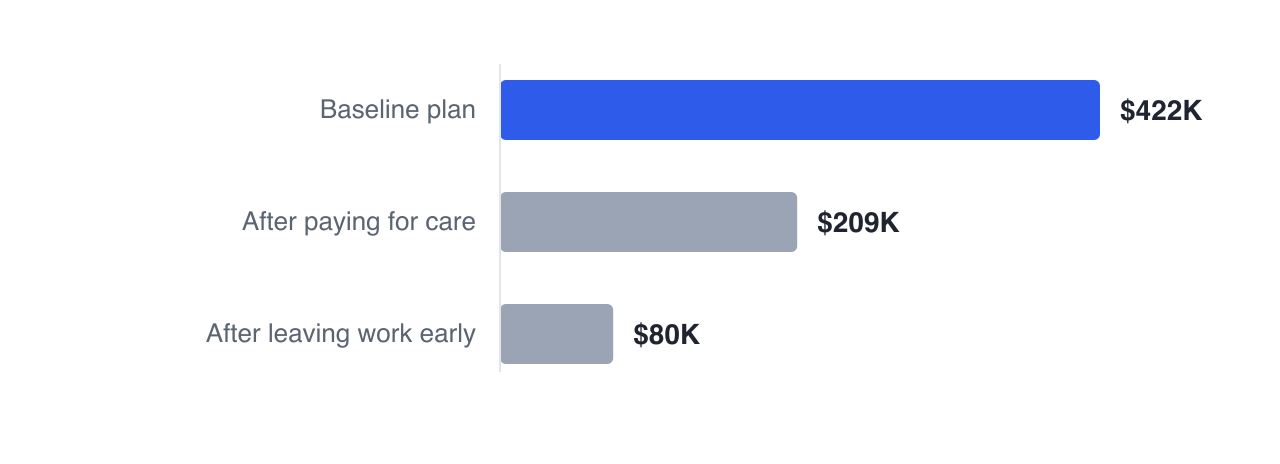
The ordering of those two bars is the practical finding. Where paid care is an option, it is frequently cheaper than the earnings it preserves — which is an uncomfortable calculation to run and a useful one to have run before the decision is urgent.
The tax mechanics that exist
A caregiver credit exists for supporting a dependent relative with a physical or mental impairment, and medical expenses paid on behalf of a dependent relative can sometimes be claimed. Both are worth checking, and neither is large relative to the costs above. They soften the arithmetic; they do not change it.
The genuinely valuable planning here is not tax. It is knowing, in advance, what the parents’ own resources cover, and what your plan can absorb without moving your own retirement date.
A care cost window and an earlier retirement age are both single-input changes, so you can see which of the two risks your plan is actually sensitive to before either arrives.
Next: annuities — an honest look at a product this tool does not model.
GlidePathEngine is an educational planning tool — not financial, investment, tax, or legal advice.