The three account types and the one question they answer
Canada has a bewildering alphabet of savings accounts — RRSP, TFSA, FHSA, RRIF, LIRA, RESP, RDSP — and most explanations hand you a comparison chart with fourteen rows. There are really only three things going on, and every account is one of them.
The only question that matters: when does the government take its cut?
Every dollar you earn gets taxed. The accounts differ in exactly one respect: when. Not whether, not how much in absolute terms — when. Sort them by that and the alphabet collapses into three groups.
| Treatment | Going in | While it grows | Coming out | Accounts |
|---|---|---|---|---|
| Tax later | Deducted from your income | No tax | Fully taxable as income | RRSP, RRIF, LIRA, LIF, spousal RRSP |
| Tax never | From after-tax money | No tax | Nothing taxable | TFSA |
| Tax now | From after-tax money | Taxed each year on income and realized gains | Only the gain is taxable, and only half of it | Non-registered (a plain investment account) |
Two accounts break the pattern in useful ways. The FHSA is the only one that is both: you deduct the contribution like an RRSP *and* take it out tax-free like a TFSA, provided you use it for a first home. The RESP has no deduction but attracts a federal grant, which behaves like a return rather than a tax break. Both get their own episodes.
Why "tax later" is not the same as "tax free"
This is where most of the confusion lives. An RRSP contribution reduces your taxable income this year, and that refund feels like a gift. It is not. It is a deferral: the entire balance — your contributions *and* every dollar of growth on top of them — comes out as ordinary income later and is taxed at whatever rate applies then.
A TFSA is genuinely different. There is no deduction going in, and there is no tax event coming out — ever. The dollar you put in has already been taxed, and that is the end of the relationship.
A non-registered account is the one with no special rules at all. Interest is taxed every year as it is earned. Dividends get their own treatment. And when you sell something for more than you paid, half of the gain is added to your income — the other half is never taxed at all.
$558,000 that is not really one number
Priya — 54, Ontario, single. $118,000 salary, $410,000 in her RRSP and $88,000 in her TFSA, planning to retire at 63.
Priya is 54, lives in Ontario and earns $118,000. Her statements add up to a tidy total, but those dollars are not interchangeable. Sorted by tax treatment, her savings look like this:
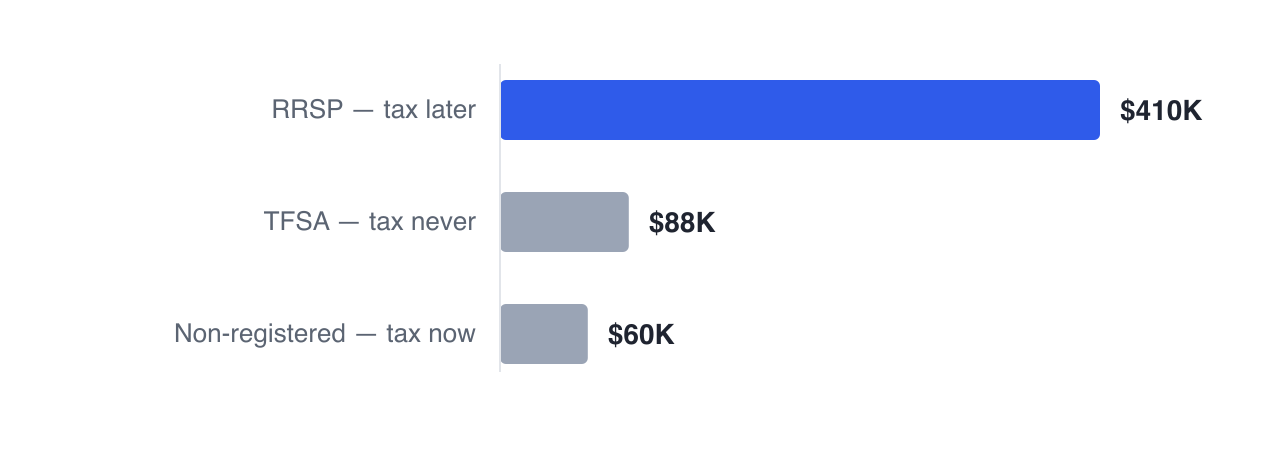
Priya's marginal rate today is 37.2% — that is the rate on her next dollar of income, and it is the rate her RRSP balance is measured against. Her RRSP is the biggest number on the page and also the one that is only partly hers. Some share of it belongs to a future tax bill.
That is not a reason to avoid an RRSP. It is a reason to stop reading the three balances as though they were the same currency, which is what a single "total savings" number quietly encourages.
What this unlocks
Almost every decision in the rest of this series is a variation on the same question. Which account should this contribution go into? Which account should this withdrawal come out of? Should this asset be held here or there? All three are asking when you want the tax to land, and at what rate.
You cannot answer any of them from the balances alone. You need the rate you face now, the rate you expect to face later, and the gap between them. That gap is the whole game, and it is where this series goes next.
Enter your balances by account type and the projection separates them the way this episode does — showing what is taxable on the way out, and when.
Next: what an RRSP deduction actually buys you — and why the refund is a loan, not a gift.
GlidePathEngine is an educational planning tool — not financial, investment, tax, or legal advice.