The three stress tests everyone should run
Most retirement worry is unfocused, which makes it both persistent and useless. Three specific tests cover most of what genuinely breaks plans, and running them converts a general unease into three answers you either accept or act on.
Test one: a poor market sequence
Not a single bad year — a sequence, arriving early in retirement, which is the sequence-of-returns risk from episode 24. The simulation does this properly by running the whole plan across a thousand return paths and reporting how it fares in the unlucky ones.
The number to look at is not the headline success rate but the tenth-percentile outcome. That is what an unlucky path leaves, and it is the difference between a plan that thins uncomfortably and one that fails outright.
Test two: retiring three years early
Involuntary early retirement is more common than people expect and costs more than the missing salary, for the double-effect reason in episode 69. Three years is a realistic shock rather than a catastrophic one, which is what makes it a useful test.
It is also a proxy for a long disability, which does the same thing to a plan: income stops, contributions stop, and drawdown starts early.
Test three: a late-life care window
Three years of care costs starting in the mid-eighties, at a realistic private rate. It lands in the years with no remaining horizon to recover, on top of already-large mandatory withdrawals, and it is the shock most plans have never modelled at all.
All three, on one plan
Priya — 54, Ontario, single. $118,000 salary, $410,000 in her RRSP and $88,000 in her TFSA, planning to retire at 63.
Priya’s baseline plan ends at $399,597 with a simulated success rate of 75.7% — and an unlucky tenth-percentile outcome of $0, which is the first test’s real answer.
Retiring three years early takes her to $37,505 and 42.8%. A $75,000-a-year care window takes her to $181,314 and 65.5%.
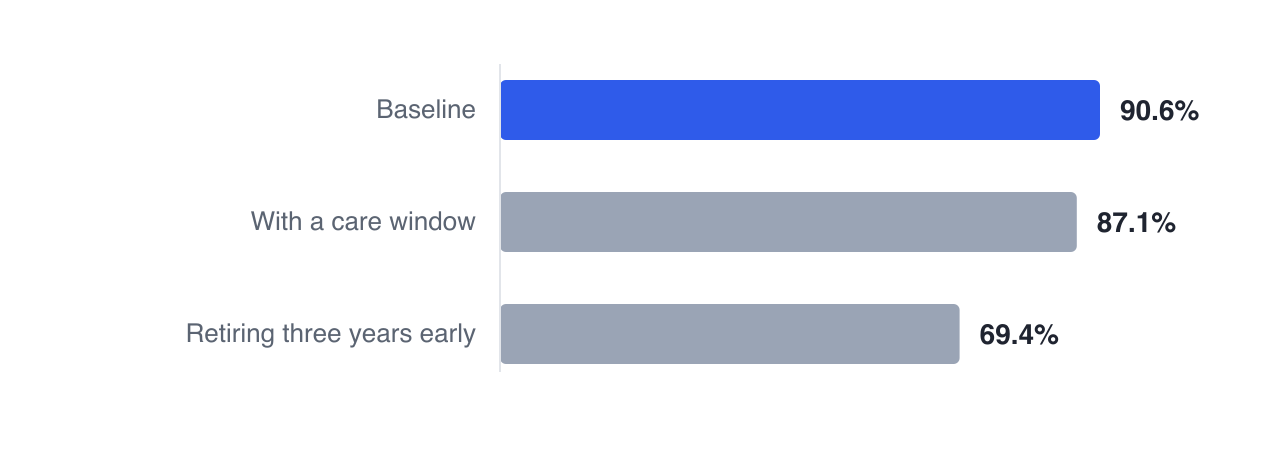
The ranking is more useful than any single figure. For Priya the retirement date dominates — so her attention belongs on employment security and on knowing her cliff age, not on the care shock she was more likely to have been worrying about.
What to do with the answers
A plan that survives all three has real margin, and the correct response is to stop worrying and possibly to spend more — the over-saving question from episode 86.
A plan that fails one of them has identified where its margin is thin, which is the single most useful thing a projection can tell you. The response depends on which one: employment security and a cliff age for the second, a care reserve or insurance for the third, spending flexibility for the first.
And a plan that fails all three is telling you something about the plan rather than about the scenarios.
A fourth test is worth adding for couples, and it is the one from episode 41: model the plan as it stands after one spouse has died. Fewer benefits, a single set of brackets, no pension splitting, and a spending need that falls by far less than half. It is the most commonly skipped scenario and among the most likely to occur.
The simulation, a lower retirement age, and a care cost window are three separate single-input changes — about thirty minutes to run and read, and worth repeating annually.
Next: rebalancing and drift — why a portfolio moves even when you do not.
GlidePathEngine is an educational planning tool — not financial, investment, tax, or legal advice.