TOSI: why paying your spouse a dividend isn’t simple
Paying dividends to a lower-income spouse used to be one of the main reasons to incorporate. The rules that ended it do not prohibit it — they price it at the top marginal rate, which amounts to the same thing unless an exclusion applies.
What TOSI does
The recipient does not need to be anywhere near the $258,482 top bracket. A student with no other income receiving a caught dividend is taxed on it as though they were the highest earner in the country.
It applies to dividends and to certain other amounts from a related business, paid to a spouse, a child, or another specified individual. So the default position for a family dividend is that it is caught, and the planning is entirely about the exclusions.
The exclusions that matter
- Excluded business — the recipient worked in the business an average of at least twenty hours a week during the year, or during any five previous years. This is the most commonly relied-upon exclusion, and it requires evidence rather than assertion.
- Excluded shares — the recipient owns at least ten percent of votes and value in a company that is not a professional corporation and earns most of its income from active business rather than services. The services carve-out excludes many consultancies.
- Reasonable return — the amount is reasonable relative to the recipient’s contribution of labour, capital and risk. Deliberately judgement-based, and applied more strictly to some family members than others.
- Age 65 — once the *owner* reaches 65, amounts paid to their spouse are excluded. This is the retirement-planning exclusion, and it is the reason TOSI can stop being a constraint at a predictable date.
That last exclusion aligns dividend splitting with pension income splitting: both become available in the mid-sixties. For an owner-manager approaching that age it is a genuine change in what the corporation can do, and it arrives on a known schedule.
What is at stake per dividend dollar
Sam — 41, British Columbia, self-employed through a corporation. No employer pension, no home yet, and a company that pays them both salary and dividends.
Sam takes $20,000 a year in dividends. Paid to a spouse who does not meet an exclusion, that amount is taxed at the top combined rate rather than the spouse’s own — which for a spouse with little other income can be a difference of thirty points or more on the same dollars.
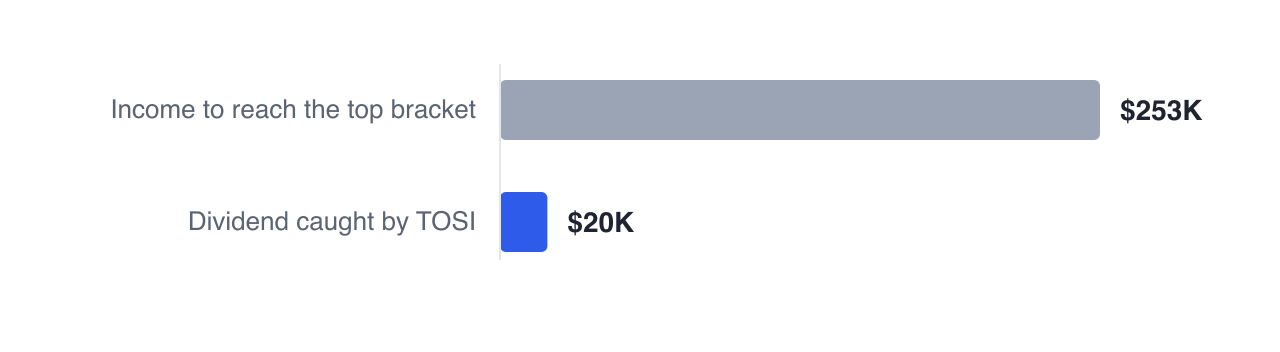
The projection models a second owner’s dividend share and flags the taxable slice as caught where no exclusion applies, taxing it at the top rate. Which means the cost of getting the exclusion wrong appears in the plan rather than in a reassessment.
What is out of scope here
Sprinkling to adult children is a real planning area and is not modelled in this projection — children are not projected as tax entities, so any figure would be invented. The spouse case is modelled because a spouse is already part of the household being projected.
This is also the episode in this series where professional advice earns its fee most clearly. The exclusions turn on facts about hours worked, share classes and contributions, and getting them wrong is expensive in a way the arithmetic elsewhere in this series is not.
The corporate section takes a second owner, their share of dividends, and which exclusion applies — so the projection taxes the amount the way the rules would rather than assuming the best case.
Next: selling the corporation, and sheltering a lifetime’s gain.
GlidePathEngine is an educational planning tool — not financial, investment, tax, or legal advice.