Where you retire changes the math
Two retirees with identical incomes, identical accounts and identical CPP can pay substantially different amounts of tax for one reason: which province they live in. The spread is wider than most of the strategy decisions in this series.
What varies
Provincial income tax brackets and rates, provincial credits including the basic personal amount and the age amount, surtaxes charged on the provincial tax itself, and income-tested health premiums. Each province sets all of these independently.
That asymmetry is worth holding onto, because it means the whole provincial question is a tax question. The retirement income itself is unaffected — a plan that moves from one province to another keeps every benefit figure and changes only what is charged on top.
The same income, five provinces
Priya — 54, Ontario, single. $118,000 salary, $410,000 in her RRSP and $88,000 in her TFSA, planning to retire at 63.
On $80,000 of income, the combined marginal rate is 28.2% in British Columbia, 29.6% in Ontario, 30.5% in Alberta, 37.2% in Nova Scotia and 36.1% in Quebec.
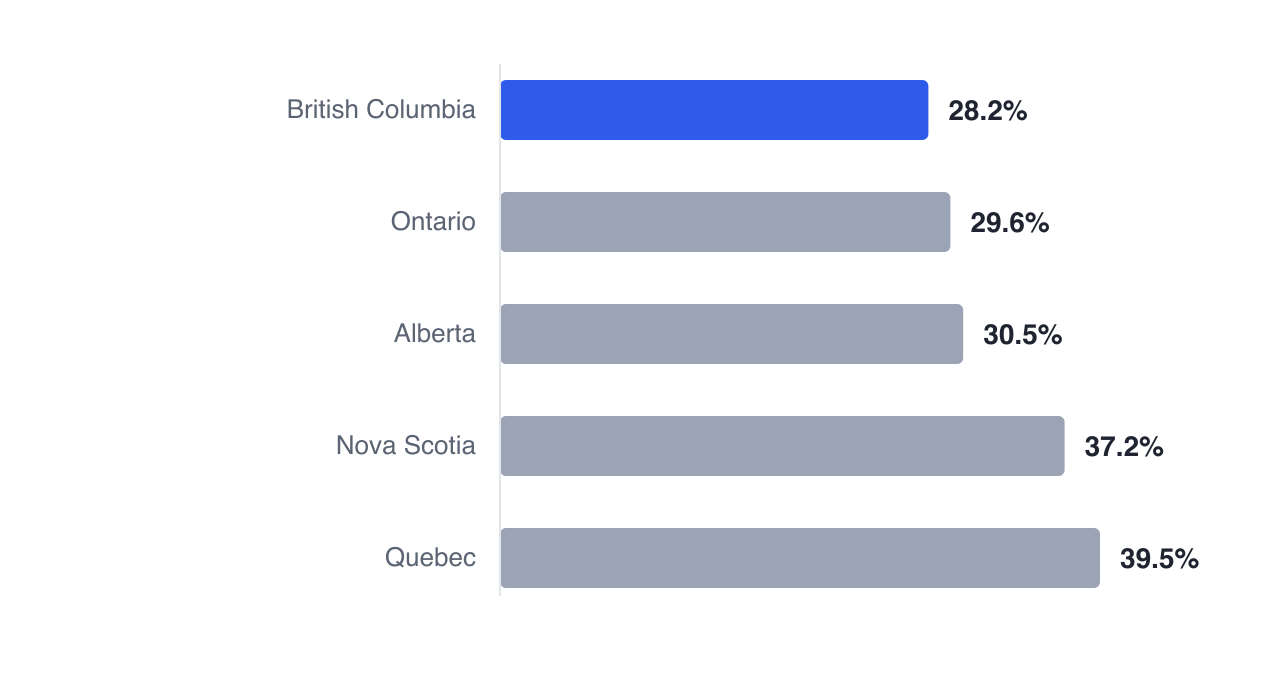
Over eleven percentage points between the extremes, applied to every marginal dollar for the rest of a retirement. That is larger than most of the strategy differences earlier in this series — and unlike them, it is not a technique but a postcode.
The ordering is also not the one folklore suggests. It is not a simple east-versus-west story, and a province with a low headline rate at one income can rank differently at another because the thresholds sit in different places.
What tax is not
A retirement is not lived on a marginal rate. Housing costs, property tax, insurance premiums, drug plan coverage, long-term care subsidies and the cost of everything else vary between provinces too, often by far more than the income tax does — and frequently in the opposite direction.
A province with higher income tax and much cheaper housing can leave a household better off in every year of a thirty-year retirement. Optimising the tax line alone is optimising one term of a much longer expression.
The honest use of a figure like the one above is as one input among several — and as a reminder that a plan built in one province and lived in another is not the plan you projected.
Two further mechanics are worth naming. Provincial age amount credits differ, which means the effective rate on a modest retirement income varies by more than the bracket table alone suggests. And a surtax is charged on the provincial tax rather than on income, so in the provinces that levy one the effective provincial rate climbs faster than the published brackets imply — which is why the combined figure has to be computed rather than read off.
Change the province in the household section and everything downstream recomputes — brackets, credits, surtax and health premium — so the difference in your own plan is measured rather than estimated from a rate table.
Next: actually moving provinces in retirement — what follows you and what does not.
GlidePathEngine is an educational planning tool — not financial, investment, tax, or legal advice.