Withholding tax on RRSP withdrawals
Withdraw from an RRSP and the institution holds back tax before sending the money. That amount is not what you owe — it is an estimate made by an institution that knows nothing about the rest of your year.
What withholding is
An RRSP withdrawal is fully taxable income. Rather than waiting for you to file, the institution remits a percentage to the CRA immediately and sends you the rest. That remittance is a prepayment credited against your eventual liability, exactly like payroll deductions on a salary.
The gap runs both ways. Someone with substantial other income will find the withholding well short of what they owe, and pay the balance at filing. Someone with almost no other income may have had too much withheld and get a refund.
The splitting trap
Because the withholding rate steps up with the size of a single withdrawal, taking several smaller withdrawals reduces the amount withheld. It does not reduce the tax owed — total income for the year is identical either way.
So splitting a withdrawal is not a tax strategy, it is a cash-flow one: more money now, and a larger bill at filing. Treated as a saving, it is how people end up owing an amount they had already spent.
The RRIF minimum exception
Withdrawals from a RRIF up to the mandatory minimum have no tax withheld at all. Not because they are untaxed — they are fully taxable — but because the rules exempt the minimum from withholding.
This is a genuine trap for a new retiree. The money arrives with nothing deducted, looks like it has been handled, and the entire tax on it is due at filing. Anything withdrawn above the minimum does have withholding applied.
Why the estimate cannot be right
Priya — 54, Ontario, single. $118,000 salary, $410,000 in her RRSP and $88,000 in her TFSA, planning to retire at 63.
Priya’s mandatory RRIF withdrawal at 72 is $43,909 — and because it is the minimum, nothing is withheld from it. The tax on it is entirely a filing-time obligation.
Her marginal rate is 37.2% while working and 19.1% in retirement. The same withdrawal made in those two years carries very different tax, and no flat withholding rate could match both.
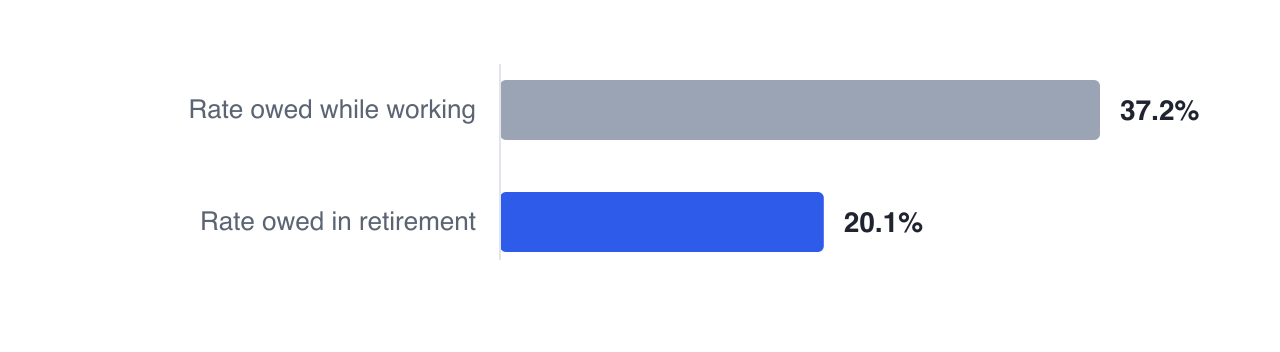
Notice that the projection reports tax on the correct basis regardless — your marginal rate applied to your whole year, which is what you will actually pay. Withholding is a cash-flow event rather than a tax event, and modelling it would add nothing to the plan.
Which leads directly to instalments
A retiree whose income arrives without adequate withholding ends up owing a balance at filing. Do that once and the CRA starts asking for the following year’s tax in quarterly instalments — which is the subject of the next episode, and the mechanism most retirees meet without warning.
The ledger reports income tax for every year of the projection computed on your full income — the number withholding is trying to approximate, and the one worth budgeting for.
Next: tax instalments — why the CRA starts asking for quarterly payments.
GlidePathEngine is an educational planning tool — not financial, investment, tax, or legal advice.